
6000 vs 6400 RAM: Which Is Better in 2026?
Disclosure: We may earn a commission when you buy through links on this page, at no extra cost to you. As an Amazon Associate I earn from qualifying purchases. Learn more

6000 vs 6400 ram kits: what the extra speed changes, how latency and stability factor in, and what suits AMD and Intel builds.
On a DDR5 system, 6000 vs 6400 ram looks like a small number difference, and in practice it is a small performance difference too. The right pick depends mostly on your processor platform, the latency of the kit and the price gap, not on the megatransfer figure alone. The product table right after this introduction lists DDR5 kits at both speeds.
The sections below explain what the numbers mean, how AMD and Intel platforms treat them, and why a tuned 6000 kit is often the better buy.


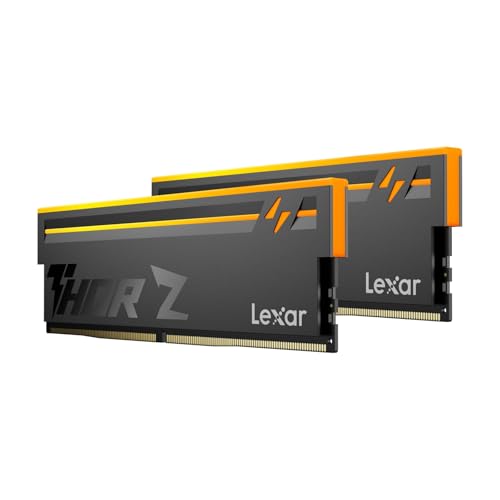


What the Speed Numbers Mean
The figures describe how many data transfers per second a memory kit can perform, measured in megatransfers per second. A 6400 kit can move about 7 percent more data per second than a 6000 kit at the same width. That sounds like a clear gain, but memory performance also depends on latency, the delay before data starts to flow.
Latency is shown as a CL number. A 6000 kit with a low CL can respond as quickly as a 6400 kit with a higher CL. To compare, convert both to real time in nanoseconds. A common formula multiplies the CL by 2000 and divides by the speed, which gives the first-word latency.
By that math, a well-tuned 6000 kit often matches or beats a looser 6400 one.
- Higher speed: more bandwidth.
- Lower CL at the same speed: faster response.
- The best kit balances both for your platform.
The AMD Sweet Spot
On AMD's AM5 platform, DDR5-6000 is widely considered the sweet spot. At this speed the memory controller and the fabric that links the cores can run in a one-to-one ratio, which keeps latency low. Above roughly 6000, many processors shift to a different ratio that adds delay, canceling much of the speed gain unless you tune settings carefully.
That is why a 6400 kit is not always faster on an AMD system, and may run at lower real performance if it falls out of the ideal ratio. For gaming, a good 6000 kit with low latency is the safest and usually best choice on AM5.
Intel Platforms
Intel's recent desktop platforms handle higher memory speeds more easily, so 6400 and beyond often work out of the box with the XMP profile, and gains can be more visible than on AMD. The difference between 6000 and 6400 is still modest in most games, at a few percent in some titles and none in others.
Check your motherboard's supported speeds and the list of qualified kits. Entry-level boards may not run fast kits at their rated speed, and a four-stick setup lowers the stable speed on most boards.
Real-World Impact
For gaming, memory speed above the sweet spot gives small gains, typically a few frames at most and often within normal variation. Higher resolutions reduce the effect further, since the graphics card sets the limit. In tasks such as compression, some creative work and integrated graphics, faster memory has more impact.
The kit's capacity and whether it is a two-module set matter more than a few hundred megatransfers. Buying a good 32GB kit that runs stably at its rated profile is worth far more than chasing the top number.
Price and Availability
6400 kits often cost more than 6000 kits of the same capacity and brand. If the gap is small and your platform supports it, take the faster one. If the gap is large, the money is better used on a stronger graphics card or more storage. Check the table for what is in stock.
Our best RAM guide compares popular kits in more detail, and the Kingston Fury Beast DDR5 review covers a widely sold option.
Timing Examples in Plain Numbers
Take two imaginary kits to see how it works. A 6000 kit with CL30 gives a first-word latency of 10 nanoseconds by the formula above. A 6400 kit with CL32 gives exactly the same 10 nanoseconds, so the faster kit offers more bandwidth with the same response time. A 6400 kit with CL40, though, lands at 12.5 nanoseconds, noticeably slower in response despite the higher speed.
That is why reading the full label matters. Look at the speed, the CL value, the voltage and the capacity together, and compare kits on that basis. Two kits with the same speed can feel very different, and the cheaper one is not always the worse one.
Heat and Voltage
Faster kits usually run at higher voltage and produce more heat. Most kits stay safe within their rated profile, but airflow around the modules helps stability, especially in cases with limited ventilation. Do not raise voltage manually unless you understand the risks, since excessive settings can shorten the life of the memory or the processor.
6000 vs 6400 ram: Which Should You Choose?
Choose 6000 if you
- Build on AMD AM5 and want the best balance of speed and latency.
- Want stable performance without manual tuning.
- Prefer the lower price.
Choose 6400 if you
- Build on an Intel platform that handles faster memory well.
- Find a kit with good latency at a small premium.
- Enjoy tuning and have a board with strong memory support.
Enabling and Checking the Profile
Memory runs at a default speed until you enable the XMP or EXPO profile in the BIOS. Without this step you will not reach 6000 or 6400, no matter which kit you buy. After enabling it, confirm the speed in a utility such as the task manager's memory tab or a system information tool.
If the system fails to boot or crashes, update the BIOS, reseat the modules, and try a slightly lower speed. Keep the kit as two modules for the easiest stability, and see our Corsair Vengeance RGB DDR5 review for an example of a kit with several speed options.
FAQ
Is 6400 faster than 6000?
On paper yes, but latency and platform limits can erase the advantage, so real gains are small.
Which is better for AMD?
6000 with low latency is the standard recommendation for AM5.
Will 6400 work on my board?
It depends on the processor and board. Check the supported speeds and the qualified kit list.
Does faster memory improve gaming a lot?
No, the gains are usually small, particularly at higher resolutions.
On balance, 6000 vs 6400 ram favors a tuned 6000 kit for AMD and value, and 6400 for Intel builds and tuners who find it at a fair price.


