
The Best Full Range Speakers Specifications for 2026: Audio Engineering Guide
Disclosure: We may earn a commission when you buy through links on this page, at no extra cost to you. As an Amazon Associate I earn from qualifying purchases. Learn more

Learn the best full range speakers specifications to check: frequency response, sensitivity, impedance and Thiele Small numbers for DIY and desktop builds.
Manufacturer spec sheets are full of charts, electrical figures and acoustic formulas, and it is hard to tell which numbers actually change how a speaker sounds. This guide is for anyone building a wooden cabinet, upgrading a pair of desktop monitors, or matching efficient drivers to a small tube amplifier. Knowing the best full range speakers specifications to look for lets you see past marketing claims and judge efficiency, tonal balance, power handling and enclosure fit on your own.
Below we explain frequency response graphs, sensitivity, impedance curves and Thiele Small parameters in plain terms, then cover cabinet types and driver care. The picks in the comparison table follow the same criteria, so you can check each spec sheet against this list.


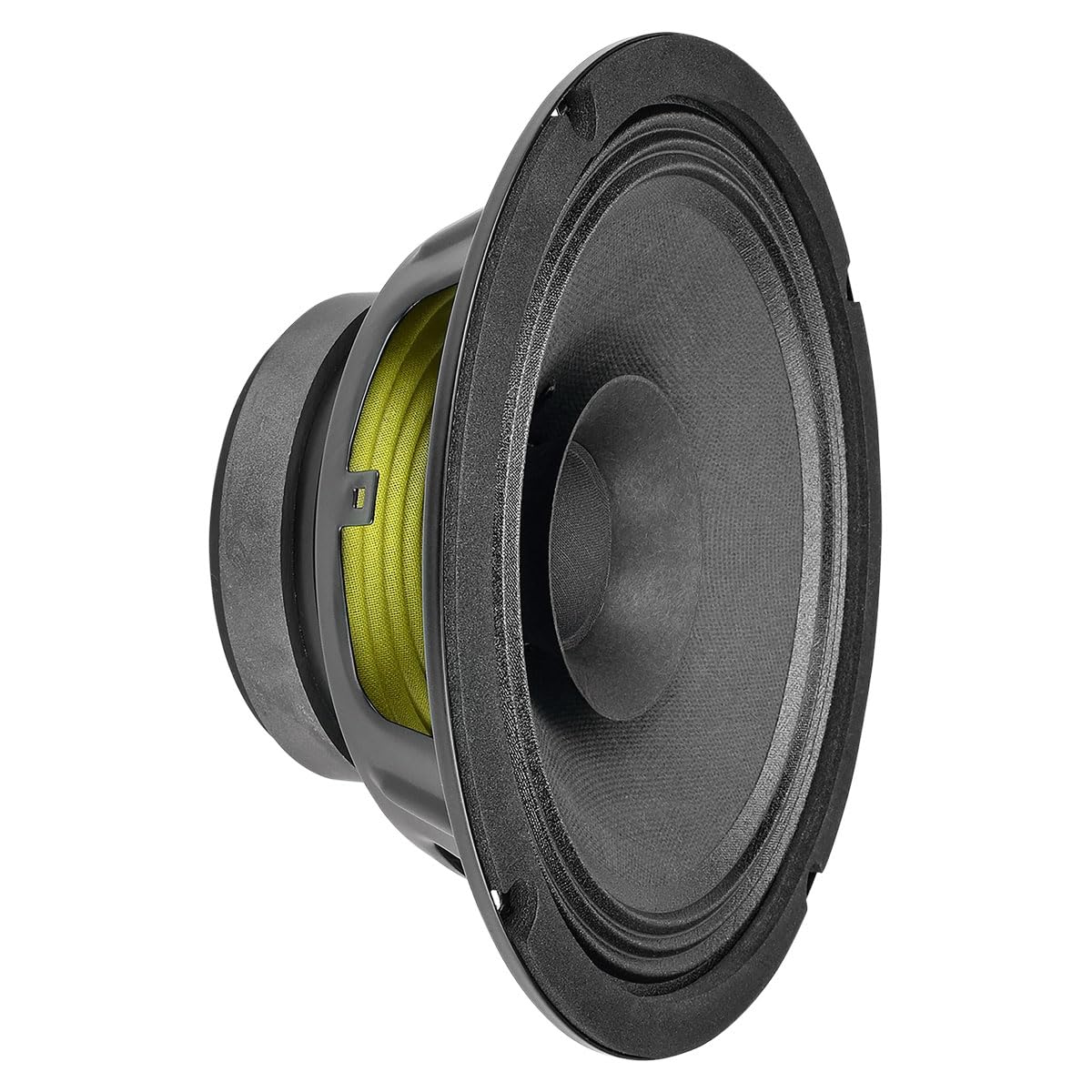


How to Choose the Best Full Range Speakers Specifications: Buying Guide
A full range driver performs well when its voice coil, magnet, cone suspension and cabinet volume work together. Read the specifications below in this order before you settle on a model.
Frequency Response Curves and Decibel Tolerance Windows
Frequency response is the range of pitches a speaker reproduces, from low bass in hertz (Hz) up to treble in kilohertz (kHz). A typical full range listing might read 45 Hz to 20,000 Hz (+/- 3 dB).
Always check the decibel tolerance that follows the range. A +/- 3 dB window describes a fairly flat, accurate output, while a sheet that leaves out the tolerance or quotes +/- 10 dB can hide midrange dips or harsh treble peaks. Prefer smooth, gradual roll-offs at both ends over jagged anomalies that color the timbre of instruments.
Sensitivity Ratings (dB at 1W/1m) and Dynamic Efficiency
Sensitivity is how loud a speaker plays when it receives one watt of power, measured from one meter away. Full range drivers usually fall into three tiers:
- Moderate sensitivity (86 dB to 89 dB): Common in compact desktop monitors. They need a solid state amplifier with fifty to one hundred watts per channel to handle loud peaks.
- High sensitivity (90 dB to 94 dB): Versatile drivers that fill a room with a modest integrated amplifier of fifteen to thirty watts.
- Very high sensitivity (95 dB and above): Specialist drivers with large Alnico or neodymium magnets. They respond well to low-powered tube amplifiers of two to eight watts.
Nominal Impedance and Phase Angle Stability
Impedance, in ohms, is the electrical load a speaker puts on the amplifier. A speaker rated at a nominal 8 ohms will not hold that value everywhere: it can climb to around twenty ohms at the driver resonance and dip toward four ohms elsewhere.
A smooth curve with a gentle phase angle keeps the amplifier in its comfortable range. That reduces heat, current clipping and harsh distortion on demanding passages.
Power Handling: Continuous RMS vs Peak Wattage
Match your system on continuous RMS power handling, not the peak figure. RMS is the heat a voice coil can shed through hours of steady playback, while peak numbers describe brief bursts.
Full range drivers usually carry modest RMS ratings, roughly thirty to eighty watts. Because efficient drivers turn electrical energy into sound so well, you rarely need more than that to reach lively listening levels in an ordinary room.
Thiele Small Parameters: Fs, Qts, and Vas
Thiele Small parameters tell a cabinet builder how the driver behaves, so they matter most for DIY projects:
- Resonant frequency (Fs): The natural resonance of the cone in free air. A lower Fs, for example in the thirties to mid forties of hertz, suggests more potential for bass extension.
- Total quality factor (Qts): A measure of electrical and mechanical damping. Low values (about 0.20 to 0.35) suit ported or back loaded horn cabinets, mid values (0.40 to 0.60) suit sealed boxes, and high values (0.70 and up) work best on open baffles.
- Equivalent compliance volume (Vas): The volume of air that is as stiff as the suspension. It guides how large the finished cabinet needs to be.
Total Harmonic Distortion (THD) and Dispersion Angle
Total harmonic distortion is the share of unwanted tones the driver adds to the signal. Good drivers keep it under about one percent across the vocal range. Check the dispersion angle too: wide, even dispersion keeps the tonal balance steady for listeners seated off to the side.
Voice Coil Inductance (Le) and High Frequency Extension
Voice coil inductance (Le), in millihenries (mH), controls how much the electrical impedance rises at high frequencies. In an ordinary woofer, high inductance works like a low pass filter and chokes off treble above roughly two thousand hertz.
Full range designs often use copper shorting rings and underhung voice coils to keep Le low, commonly below 0.1 mH. That lets the coil follow fast transients and carry treble toward twenty kilohertz without a crossover network.
Mechanical Suspension Compliance (Cms) and Moving Mass (Mms)
Cms and Mms describe how easily the cone moves and how heavy the moving parts are. Moving mass counts the cone, voice coil, former and the air load, in grams. Full range drivers are light, often somewhere between five and fifteen grams.
A light moving assembly on a compliant surround can start and stop quickly. That helps the driver reveal small details in acoustic instruments and room ambience that heavier multi way cones can smear.
Cabinet Loading Enclosure Specifications
A cabinet has to keep the rear wave of the cone from cancelling the front wave, and the type you pick shapes the bass character.
Ported Bass Reflex Alignments
A reflex cabinet uses a tuned duct that turns rear cone energy into extra bass at the front. Check the port diameter, flare and length in the plans, since an undersized port can cause audible air noise on strong bass notes.
Back Loaded Acoustic Horn Structures
These cabinets have internal baffles that widen from the rear chamber to a large mouth at the front. Published horn plans list throat area, expansion rate and length, and a well matched horn can raise low frequency output by several decibels.
Open Baffle Dipole Wooden Planks
An open baffle drops the box and mounts the driver on a flat board. The result is a dipole radiation pattern with little boxy coloration and a wide, airy soundstage, though it needs more room clearance and gives less bass.
Maintenance and Handling Guidelines for Precision Drivers
Four simple habits protect a driver and keep the specifications you paid for intact.
- Stay within the rated excursion limit (Xmax): Pushing a small cone past its linear travel can make the voice coil bottom out and damage the former.
- Protect paper cones and surrounds from moisture: Keep indoor humidity in a steady middle range, around forty to sixty percent, so paper parts do not absorb water vapor.
- Tighten mounting screws in a crisscross pattern: Even torque avoids warping a cast aluminum basket.
- Power down before changing interconnects: This avoids turn-on pops and voltage spikes that can damage whizzer cones or stretch voice coils.
Frequently Asked Questions
Which speaker specification matters most for sound quality?
A smooth frequency response within a tight +/- 3 dB window matters most, together with low distortion. Total harmonic distortion under about one percent across the vocal range is a good sign of natural sound. Treat the two numbers as a pair, since either one alone can mislead.
What is the difference between RMS power and peak power?
RMS power is the level a speaker can take continuously, while peak power is a short burst figure. Use RMS when pairing speakers with an amplifier. Peak ratings are mostly a marketing number and say little about long listening sessions.
Why is speaker sensitivity so important?
Sensitivity tells you how much amplifier power you need for a given volume. A speaker above ninety decibels reaches realistic levels with far less power than an 86 dB design. That makes it the key figure if you plan to use a small tube or low wattage amplifier.
What does speaker impedance tell me about amplifier compatibility?
Nominal impedance shows how hard the speaker is for the amplifier to drive. An eight ohm speaker is an easy load for nearly every amplifier. A four ohm speaker draws more current, so it needs an amplifier rated for that load.
Closing Thoughts
Learning to read a spec sheet turns speaker shopping from guesswork into a confident decision. Check the frequency response tolerance, match sensitivity to your amplifier, and line up Thiele Small values with the cabinet you plan to build or buy. Then compare the models in the product table above against those numbers to find a setup that suits your room and your music.


