
Best Mid Range Speakers Car Audio for 2026: Vocal Clarity, Sensitivity, and Buyer Guide
Disclosure: We may earn a commission when you buy through links on this page, at no extra cost to you. As an Amazon Associate I earn from qualifying purchases. Learn more

Vocals buried under road noise? Find the best mid range speakers car audio drivers by size, sensitivity and impedance, with a buyer guide for every build.
Many drivers add a powerful subwoofer to the trunk and crisp tweeters to the dash, only to find the music sounds hollow. The bass booms and the cymbals sizzle, but lead vocals, electric guitars and snare drums get buried under highway road noise. The band from roughly 200 Hz to 5,000 Hz carries most of the vocal and instrument detail, and dedicated midrange drivers handle it. Choosing the best mid range speakers car audio upgrades means matching cone diameter, sensitivity (dB) and impedance (4 ohm vs 8 ohm) to your amplifier and door panels. Check the comparison table below to see the picks side by side.
Before ordering, note that "mid range car speakers" can mean two things to installers. One is a dedicated midrange frequency driver, used in 3 way component systems and high output Pro Audio doors. The other is a mid priced coaxial or component speaker. This guide covers dedicated midrange drivers first, along with full door upgrades.




Who Should Buy Which Car Audio Midrange Speaker?
The right driver depends on your system goal: refined vocal staging, sheer loudness, or a simple factory upgrade. Each build below points to a different type of midrange speaker.
Sound Quality (SQ) Builds Upgrading a 3 Way Front Stage
Audiophiles building an active or passive 3 way front stage should pair a 6.5 inch door midbass woofer, a 2.5 to 4 inch dash or A pillar midrange driver and a 1 inch silk dome tweeter. Moving the midrange frequencies (about 300 Hz to 4,500 Hz) out of the lower door and up to the dash corners or A pillars raises the singer's voice toward eye level. The result is a more natural, wider vocal image across the dashboard.
High Output Pro Audio ("PA Style") and Loud Subwoofer Systems
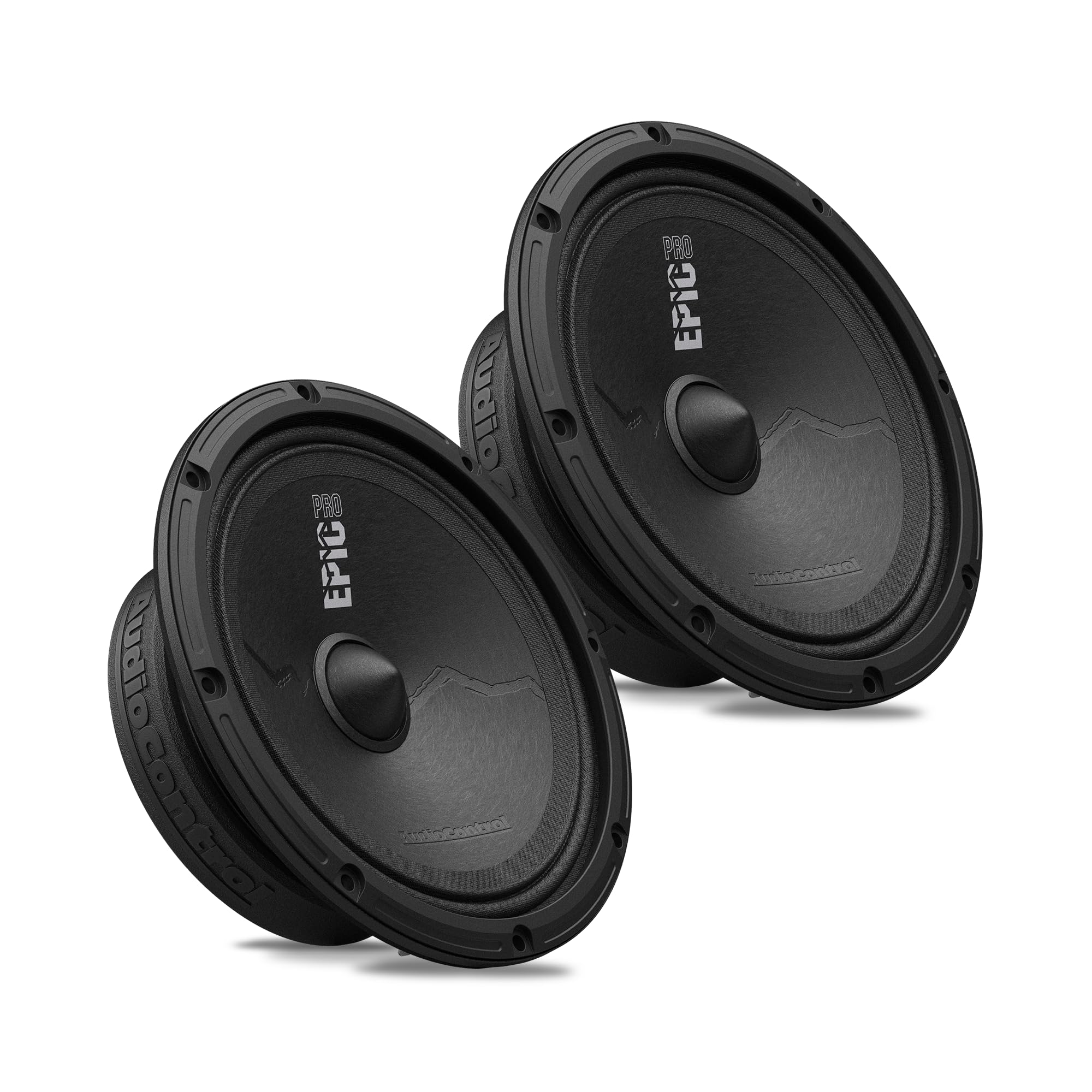
If you run a large trunk subwoofer or drive a Jeep or convertible with the top down, standard 88 dB rubber surround door speakers get drowned out. High output builds call for 6.5 inch or 8 inch Pro Audio style midranges, which often use treated paper cones, cloth surrounds, aluminum phase plugs ("bullet mids") and sensitivity around 94 dB to 99 dB. Driven by an external 4 channel amplifier, a pair of high sensitivity pro mids keeps vocals clear over loud bass.
Factory Head Unit Replacements Wanting Clearer Door Vocals
Drivers replacing worn paper factory speakers in 6.5 inch or 6x9 inch door slots, without adding an amplifier, should choose high sensitivity (91 dB or more) wideband or coaxial door speakers. Look for 3 to 4 ohm models with lightweight polypropylene, woven glass fiber or mica cones, which respond well to the modest power of a factory radio.
Key Technical Specs to Compare in Car Midrange Speakers
Dedicated Midrange Drivers vs Midbass Woofers vs Coaxials
These three driver types are not interchangeable, because each is built for a specific frequency band. Do not buy a Pro Audio midrange expecting deep bass from an unamplified door.
- Dedicated Midrange Driver (2.5", 3", 3.5", 6.5" PA Mid): Uses a stiff, short throw suspension to play from about 120 to 300 Hz up to 5,000 to 8,000 Hz. It needs a high pass crossover so low bass does not bottom out the voice coil.
- Midbass Woofer (6.5", 6x9", 8"): Has a wide rubber surround and long excursion (Xmax) to play from about 60 Hz to 300 Hz in the lower doors.
- Full Range Coaxial Speaker: Mounts a small tweeter in the middle of a woofer cone to cover roughly 65 Hz to 20,000 Hz from one factory style location.
Sensitivity (dB at 1W/1m): Loudness Per Watt
Sensitivity tells you how loud a speaker plays for a given power, and every 3 dB gain is equal to doubling amplifier wattage. A 95 dB midrange gets about the same volume from 50 watts as an 89 dB speaker gets from 200 watts. For factory radios or modest 50W x 4 amplifiers, look for ratings between about 91 dB and 98 dB so vocals stand out without clipping the amp.
Bullet Phase Plugs vs Dust Caps vs Sealed Back Midranges
The center of a 6.5 inch midrange cone tells you a lot about its voicing. Here are the three common designs:
- Metal "Bullet" Phase Plug: A solid machined aluminum bullet replaces the glued dome. It pulls heat off the voice coil and reduces high frequency cancellation across the cone face, extending upper vocal clarity.
- Felt or Paper Dust Cap: Gives a smoother, warmer and less aggressive upper midrange, which suits interior SQ listening builds.
- Sealed Back Basket Midrange: Encloses the rear of the cone in a closed basket, so it can share a door cavity or kick panel with a big woofer without the woofer's air pressure moving the midrange cone.
Impedance (2 Ohm vs 4 Ohm vs 8 Ohm) and Amplifier Matching
Match the speaker's impedance to what your amplifier is designed to drive. Pro Audio midranges come in both 4 ohm and 8 ohm versions, while OEM upgrade speakers are often 2, 3 or 4 ohm. Most car amplifiers deliver their rated power into a 4 ohm or 2 ohm load, so a single 8 ohm midrange on a 4 ohm channel receives noticeably less power.
So why do 8 ohm car mids exist? Installers who run two 8 ohm midranges per door wire them in parallel (8 ohm divided by 2 gives a 4 ohm final load), which presents a safe 4 ohm load to the amplifier.
Mounting Depth, Neodymium Magnets, and Voice Coil Size
Measure your available mounting depth before buying, because a heavy midrange can hit the window glass. Roll the window all the way down and measure between the door skin and the glass track. Many large ferrite magnet pro mids need roughly 2.75 to 3.25 inches of depth and may need a 1/2 inch MDF or HDPE spacer ring. If your doors or dash corners are shallow, choose neodymium magnet drivers, which deliver strong magnetic force in a much slimmer body, often around 1.75 to 2.2 inches deep.
Comparing Car Audio Midrange Speaker Types Side by Side
Matching the driver style to your system goals keeps vocals rich rather than harsh or thin. The table below summarizes typical ranges for each type.
| Midrange Speaker Type | Frequency Range | Sensitivity | Amp Required? | Best Car Audio Build |
|---|---|---|---|---|
| 2.5" to 3.5" SQ Dash/Pillar Mid | 250 Hz to 7,000 Hz | 87 to 91 dB | DSP / 3 way crossover | Audiophile 3 way dashboard staging |
| 6.5" Pro Audio Bullet Midrange | 120 Hz to 8,000 Hz | 94 to 98 dB | Yes (75W to 200W RMS) | High output SPL & loud subwoofer builds |
| 6.5" Sealed Back Midrange | 350 Hz to 6,000 Hz | 93 to 96 dB | Yes (with 250Hz+ HPF) | Multi speaker doors sharing air space |
| 6.5" / 6x9" Coaxial / Component | 60 Hz to 20,000 Hz | 90 to 93 dB | Optional (works on radio) | All in one factory door replacement |
Price Tiers (Per Pair of Midrange Drivers)
Prices per pair fall into three rough tiers, and each tier changes the materials and power handling you get.
Budget Factory Dash Replacements & Entry Pro Mids (Under $55 per Pair)
Under about $55 per pair, you can find 3.5 inch dash coaxial or midrange drop ins for many popular vehicles, or entry 6.5 inch ferrite magnet Pro Audio midrange pairs rated around 100W to 150W RMS. Either option usually gives a clear jump in vocal volume over worn stock paper cones.
Core High Sensitivity Bullet Mids & SQ Cones (About $55 to $130 per Pair)
Around $55 to $130 per pair, you see 6.5 inch and 8 inch cast aluminum basket Pro Audio mids with larger voice coils, machined aluminum phase plugs and 96 dB or higher efficiency. This tier also includes carbon fiber, glass fiber or pressed paper SQ 3 inch midranges for 3 way component builds.
Competition Neodymium & Audiophile Reference Drivers (About $130 to $280+ per Pair)
From around $130 to $280 and up per pair, expect lightweight neodymium motor pro mids with high RMS handling in a shallow body, water resistant marine style mids, and audiophile 3 inch dome or cone midranges. Many of these use copper shorting rings or similar motor designs aimed at lowering distortion.
Common Mistakes That Blow Car Midrange Speakers
Most failed midranges die from a few avoidable setup errors rather than poor build quality. Watch for these five.
- Sending full range bass into a midrange without a High Pass Filter (HPF): This is the most common way to destroy new midrange speakers quickly. They have short suspension travel and are not subwoofers, so set your amplifier or DSP HPF between 120 Hz and 250 Hz (12 dB or 24 dB/octave) for 6.5" pro mids, and 300 Hz to 400 Hz for 3" dash mids.
- Turning bass boost or loudness on until the amplifier clips: A small amplifier pushed into clipping creates heat that can burn out a voice coil rated for much more power. Set gain cleanly and leave bass boost off.
- Mounting directly to bare sheet metal: Bare door metal vibrates and lets rear sound waves cancel front waves. Apply butyl sound deadening around the speaker hole and use a closed cell foam ring to seal the speaker face against the door card.
- Buying 8 ohm Pro Audio mids for a weak factory radio: An 8 ohm speaker draws less power from a factory head unit, so choose 4 ohm (or 3 ohm) unless you are wiring two 8 ohm speakers in parallel on an external amp.
- Wiring one door speaker out of phase: If one speaker pushes out while the other pulls in, lower midrange frequencies cancel in the center of the car. Double check positive and negative terminals on every door.
Installation, Crossover Tuning, and Door Treatment Tips
For warm, punchy vocals from a 6.5 inch door midrange without harshness at volume, set both a High Pass Filter (HPF) and a Low Pass Filter (LPF), which together form a bandpass crossover. On a 6.5 inch Pro Audio midrange paired with a silk dome tweeter, an HPF around 120 Hz to 160 Hz keeps the cone from flopping on heavy bass drops. An LPF around 3,500 Hz to 5,000 Hz lets the tweeter take over smoothly, so the midrange does not beam from down by your ankles.
Doors collect rainwater that runs down the outside of the window glass. Install a silicone speaker baffle (with the bottom of the back cup trimmed open for airflow) or a rain drip guard over the magnet so water never reaches the voice coil gap and causes rust.
Door treatment matters as much as the driver itself. Add a layer of butyl deadening to the outer door skin behind the speaker, seal any large factory holes in the inner panel, and use a spacer ring to angle or deepen the mount if needed. These steps tighten midrange response and reduce rattles.
Frequently Asked Questions
What is the difference between a midrange speaker and a coaxial speaker in car audio?
A coaxial speaker is a 2 way all in one unit, while a dedicated midrange speaker has no tweeter. The coaxial pairs a midbass woofer cone with a small center tweeter to play from about 65 Hz up to 20,000 Hz. A dedicated midrange uses a lighter cone and stiffer surround tuned for roughly 150 Hz to 6,000 Hz in component or Pro Audio systems.
Do I need an amplifier for mid range car speakers?
For Pro Audio 6.5 inch bullet midranges, yes, an external 4 channel amplifier with a built in high pass filter is strongly recommended. Standard 3.5 inch dash speakers or 92 dB 4 ohm door replacements can run from factory radio power. A compact 50W x 4 amp still improves dynamics and clarity in either case.
What does the metal "bullet" in the middle of a car speaker do?
The bullet is a phase plug that replaces the paper dust cap. It reduces high frequency cancellation from opposite sides of the cone and acts as a heat sink that helps cool the voice coil during loud play.
Should I buy 4 ohm or 8 ohm midrange speakers for my car?
Buy 4 ohm speakers if you run one midrange per door on one amplifier channel. Choose 8 ohm only when installing two per door wired in parallel, since two 8 ohm speakers in parallel make a 4 ohm load that suits a standard 4 channel amplifier.
What frequency should I cross over 6.5 inch midrange car speakers at?
Set the high pass filter between 120 Hz and 160 Hz at a 12 dB or 24 dB/octave slope for a 6.5 inch Pro Audio midrange. You can go to 180 Hz to 200 Hz at very high volumes. For a small 3 or 3.5 inch dash midrange, set the HPF between 300 Hz and 450 Hz.
Final Thoughts
Selecting the best mid range speakers car audio drivers comes down to matching driver style and impedance to the rest of your system. For loud subwoofer builds that need vocals cutting through the cabin, pair 4 ohm 6.5 inch Pro Audio bullet midranges (95 dB or higher) with a 4 channel amplifier high passed near 140 Hz. For an audiophile dashboard soundstage, add 3 or 3.5 inch SQ midranges in the dash or pillars alongside door midbass woofers. Compare the picks in the table above to bring vocal detail back to your drive.


